Created on 25 August 2026
Linear motor and ball screw drives solve the same CNC-axis problem in different ways. The choice affects cycle time, surface quality, thermal control, maintenance and the machine configuration a production line needs. Ball screws still serve most general machining well. Linear motors are gaining ground where speed, contour control and repeatable precision determine output.
A ball screw converts servo-motor rotation into linear travel through the coupling, screw and nut. It is proven, economical and well suited to machines that need thrust, simple service and effective protection in ordinary cutting environments.
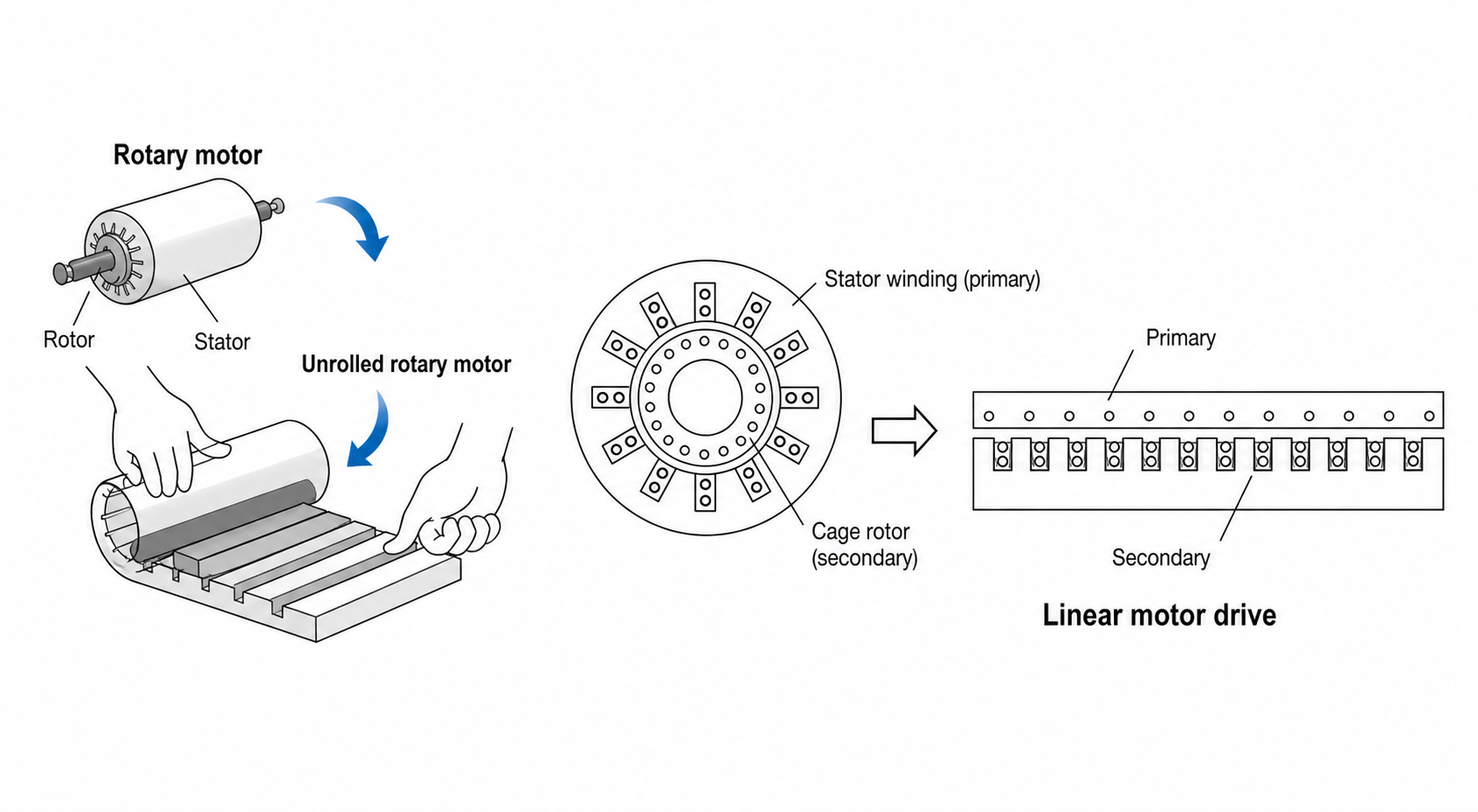
A linear motor moves the slide directly. The stator is fixed to the machine, the moving element is mounted on the axis, and the drive eliminates the screw, nut and coupling. This direct path improves axis response, but it also makes the machine structure, encoder, cooling and control tuning more critical.
The mechanical chain in a ball screw system introduces backlash, wear and thermal movement that the machine builder must manage with preload, cooling, compensation and feedback. It remains easier to maintain and more tolerant of demanding shop conditions. For heavy roughing and general-purpose work, that practicality still matters.
Linear motors remove the mechanical conversion stage, so they suit fast reversals, short blocks and long travel at high feed rates. They also demand stronger thermal management, sealed protection and disciplined chip control. Iron chips can be attracted to iron-core motors, and a direct-drive vertical axis needs a suitable brake or counterbalance strategy. Direct drive is not a shortcut to accuracy; it is a higher-level machine system.
Ball screw CNC machines remain a strong fit for general milling and turning, larger stock removal, stable feed profiles, limited capital budgets and workshops that need familiar maintenance. They also remain the practical choice for many heavy-duty machines.
Linear motor CNC machines are better matched to high-speed mould work, graphite machining, precision electronics, optical and medical components, five-axis contouring and long-travel high-speed equipment. Their value appears when frequent acceleration changes, high surface requirements or shorter cycles directly improve production output.
The selection should start with the part and process: axis travel, moving mass, cut forces, programmed motion, tolerance, surface requirement, coolant, chip load, temperature, uptime target and maintenance capability. A drive type alone does not define the result.
Ball screws and linear motors will coexist. Ball screw technology continues to improve through higher-precision designs, cooling and better compensation, so it will remain the foundation of the broader CNC market.
The direction is clearer in high-speed precision work. As machining centres for moulds, graphite, 3C components, optics and fine medical parts demand faster interpolation and consistent finishes, linear-motor axes will move from specialist equipment into more standard high-performance configurations. Better cooling, sealing, controls and locally available linear motors and encoders are reducing the barrier to adoption.
Chinese machine-tool builders are part of that shift. They can now offer direct-drive CNC platforms with a stronger price-to-capability position than earlier imported-only solutions. The buyer still needs a real machining trial, but the technology is no longer reserved for a narrow premium market.
Kazida Global is a global machine tool supplier. We see linear motor drive becoming a core specification for high-speed CNC production, not a niche feature. Manufacturers building capacity for fast, precision parts should put direct-drive machines at the centre of the next equipment plan. Chinese builders now provide credible linear-motor CNC options with the capability and price-to-performance needed to compete for that work. Kazida Global supplies new and inspected used CNC machine tools, customized machines and production-line solutions, and can match the machine configuration to the parts that must be made.
They remove the screw drive from the motion path, but accuracy still depends on the structure, encoder, thermal control, assembly and cutting process. A well-designed ball screw machine can also meet demanding work.
When faster acceleration, short-cycle contouring, long travel or stable precision improves throughput or protects part quality enough to recover the added investment.
Yes. Share the drawing, material, tolerance, surface requirement, annual volume, cycle-time target and site conditions. Kazida Global can compare new, inspected used and customized CNC machine options against the production requirement.
Sign up for updates