Created on 18 September 2026
100 EV Components and the Manufacturing Processes Behind Them
Electric vehicles combine battery hardware, electric drive units, power electronics, thermal systems, charging hardware, chassis controls, and safety structures. Each subsystem creates a different manufacturing requirement. Some parts need CNC machining and tight geometric control. Others depend on stamping, die casting, injection molding, winding, brazing, sealing, or electrical assembly.
This guide turns a 100-component EV reference list into a practical manufacturing checklist. It is written for CNC machine shops, metalworking companies, component suppliers, contract manufacturers, and engineering teams reviewing new EV programs.
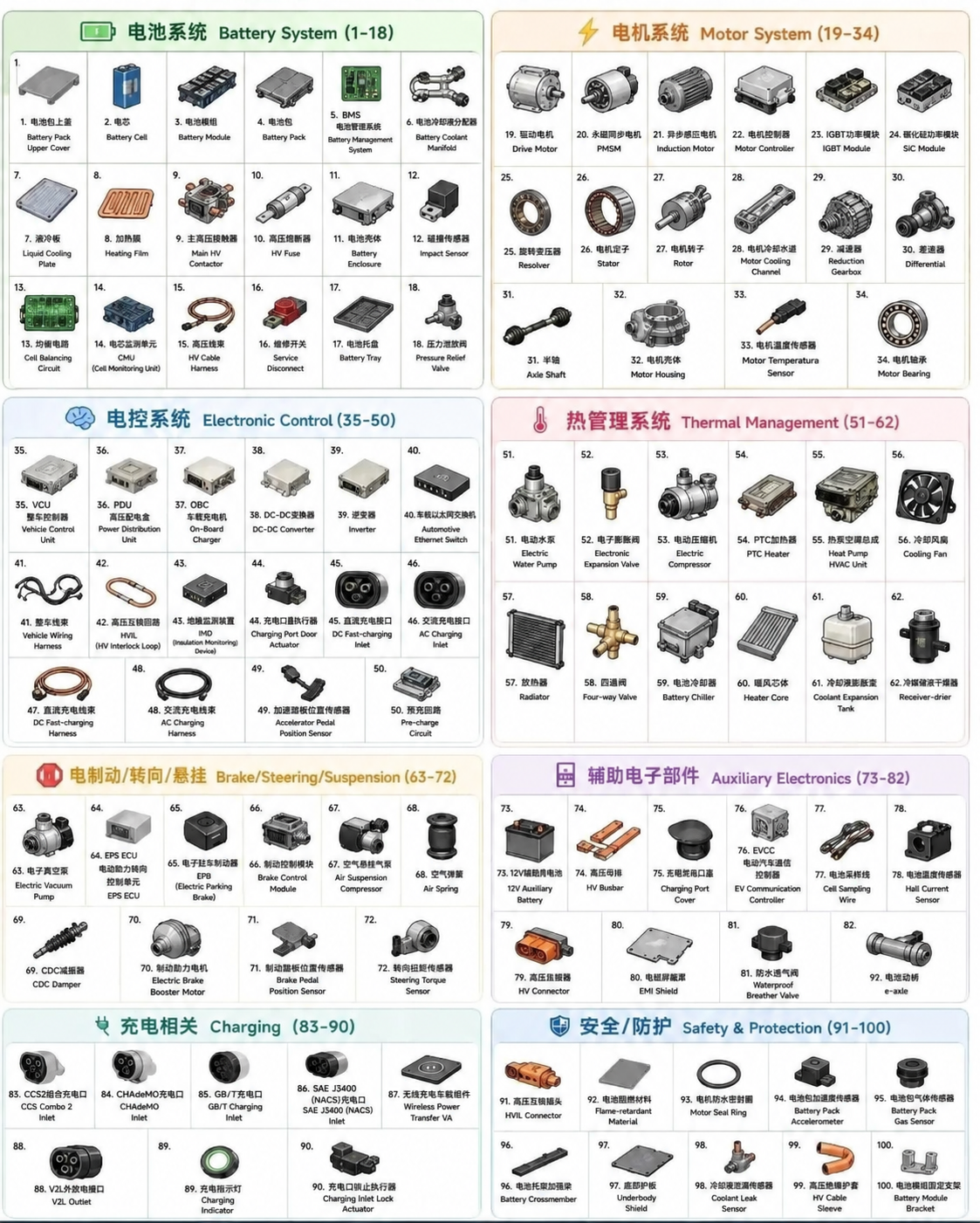
The list focuses on the form of the part and the production work it usually creates. "Machining relevance" does not mean that every part is fully machined. It identifies where CNC turning, milling, drilling, boring, grinding, deburring, inspection, fixture design, or secondary machining may enter the supply chain.
For a quotation, the drawing still controls. Confirm the material, heat treatment, coating, tolerance, sealing requirement, annual volume, prototype quantity, inspection plan, and customer-specific standards before selecting equipment or a process route.
| No. | Component | Typical part form | Common production route | Machining relevance |
|---|---|---|---|---|
| 1 | Battery pack upper cover | Sheet or formed enclosure cover | Stamping, laser cutting, welding, sealing | Hole patterns, sealing faces, inserts, and flatness may need CNC finishing and inspection. |
| 2 | Battery cell | Cylindrical, prismatic, or pouch cell | Cell manufacturing and electrical assembly | Manufacturing is cell-specialized; fixtures, trays, and test tooling create machining demand. |
| 3 | Battery module | Cell carrier and structural assembly | Stamping, molding, busbar assembly, fastening | Module frames, end plates, and locating features may require milling, drilling, or tapping. |
| 4 | Battery pack | Integrated high-voltage enclosure | Fabrication, joining, sealing, electrical assembly | Pack interfaces, mounting points, and sealing surfaces often need CNC machining and metrology. |
| 5 | Battery management system (BMS) | Electronics housing and PCB assembly | PCB assembly, enclosure machining or molding | Aluminum housings, connector apertures, and thermal interfaces can require CNC work. |
| 6 | Battery coolant manifold | Machined or molded fluid manifold | CNC machining, die casting, molding, leak testing | Internal passages, threaded ports, sealing grooves, and pressure testing are common requirements. |
| 7 | Liquid cooling plate | Flat plate with internal coolant channels | Extrusion, brazing, friction-stir welding, CNC finishing | Channel geometry, port faces, gasket grooves, and flatness are typical machining checkpoints. |
| 8 | Heating film | Flexible resistive heating element | Printed or etched circuit, lamination, electrical testing | Tooling plates, carrier fixtures, and connector parts may be machined rather than the film itself. |
| 9 | Main high-voltage contactor | Sealed electromechanical module | Precision assembly, molding, stamping | Contact housings, terminals, and test fixtures require controlled dimensions and clean assembly. |
| 10 | High-voltage fuse | Compact protective device | Stamping, brazing, ceramic or polymer assembly | Fuse holders, busbar interfaces, and mounting hardware may require turning or milling. |
| 11 | Battery enclosure | Sealed structural housing | Sheet-metal fabrication, extrusion, casting, welding | Mounting faces, coolant ports, threaded holes, and sealing lands are frequent CNC operations. |
| 12 | Impact sensor | Small sensor housing | Die casting, injection molding, PCB assembly | Sensor housings, brackets, and calibration fixtures need repeatable holes and datum control. |
| 13 | Cell balancing circuit | PCB or compact electronic module | PCB assembly and electrical test | Fixtures, heat spreaders, housings, and connector supports create secondary machining work. |
| 14 | Cell monitoring unit (CMU) | Electronics module with connector housing | PCB assembly, molding, enclosure assembly | Housing apertures, mounting bosses, and thermal contact surfaces may need finishing. |
| 15 | HV cable harness | Insulated cable and terminal assembly | Cable cutting, crimping, overmolding, electrical test | Terminals, shields, brackets, and routing fixtures require precision fabrication. |
| 16 | Service disconnect | Manual high-voltage disconnect module | Stamping, molding, assembly, dielectric test | Connector shells, lever parts, and mounting features may use CNC or insert molding. |
| 17 | Battery tray | Structural tray or crossmember assembly | Stamping, extrusion, casting, welding | Datum pads, mounting holes, threaded inserts, and distortion control matter in machining and inspection. |
| 18 | Pressure relief valve | Small valve and vent assembly | Turning, molding, sintering, assembly, pressure test | Valve bodies, threads, seats, and sealing surfaces are typical precision-machined features. |
| No. | Component | Typical part form | Common production route | Machining relevance |
|---|---|---|---|---|
| 19 | Drive motor | Integrated rotating power unit | Stamping, winding, casting, machining, assembly | Rotor shafts, housings, bearing seats, and end covers require turning, milling, and balancing. |
| 20 | Permanent magnet synchronous motor (PMSM) | Stator, rotor, shaft, and housing | Electrical steel stamping, winding, magnet assembly | Shaft journals, rotor interfaces, and housing bores demand tight concentricity and runout control. |
| 21 | Induction motor | Stator and squirrel-cage rotor | Stamping, casting, winding, machining | Shafts, end shields, bearing seats, and housings create repeatable CNC work. |
| 22 | Motor controller | Power electronics enclosure | Die casting, machining, PCB and power-module assembly | Baseplates, cooling interfaces, connector apertures, and sealing grooves need controlled machining. |
| 23 | IGBT power module | Power semiconductor package | Semiconductor packaging, brazing, electrical test | Heatsinks, cold plates, busbars, and mounting frames can require milling and flatness inspection. |
| 24 | Silicon carbide (SiC) power module | High-temperature power package | Semiconductor packaging, sintering, electrical test | Thermal substrates, housings, and precision interfaces require surface and dimensional control. |
| 25 | Resolver | Rotary position sensor | Stamping, winding, precision assembly | Rotor and stator carriers, shafts, and alignment fixtures may be turned or milled. |
| 26 | Motor stator | Laminated core with copper winding | Electrical steel stamping, stacking, winding, impregnation | Stator housings, end faces, and winding tooling create machining and inspection demand. |
| 27 | Motor rotor | Laminated or cast rotating assembly | Stamping, casting, shaft insertion, balancing | Rotor shafts, magnet pockets, splines, and balance features are common CNC work. |
| 28 | Motor cooling channel | Internal housing passage or jacket | Die casting, extrusion, drilling, machining, pressure test | Port faces, channel interfaces, seals, and leak-test fixtures need precise machining. |
| 29 | Reduction gearbox | Gear train and housing | Gear hobbing, grinding, casting, CNC machining | Gear teeth, bearing bores, shafts, and housing datums require turning, grinding, and coordinate inspection. |
| 30 | Differential | Gear carrier and differential gears | Forging, machining, heat treatment, gear cutting | Gear seats, bearing bores, flanges, and runout control are core machining requirements. |
| 31 | Axle shaft | Forged or bar-stock shaft | Forging, turning, spline rolling, heat treatment | Journals, splines, threads, and balancing call for turning, grinding, and inspection. |
| 32 | Motor housing | Cast or machined enclosure | Die casting, sand casting, CNC machining | Bearing bores, stator fits, coolant passages, and sealing faces are high-value machining features. |
| 33 | Motor temperature sensor | Sensor with probe or molded housing | Sensor assembly, molding, calibration | Probe bodies, threaded bosses, clips, and test fixtures may be machined. |
| 34 | Motor bearing | Precision rolling-element bearing | Forging, turning, grinding, heat treatment, assembly | Raceway accuracy and surface finish are specialist bearing operations; related shafts and seats need precision machining. |
| No. | Component | Typical part form | Common production route | Machining relevance |
|---|---|---|---|---|
| 35 | Vehicle control unit (VCU) | Electronics enclosure and PCB assembly | Die casting or molding, PCB assembly, test | Enclosures, connector openings, heat spreaders, and mounting features may be machined. |
| 36 | Power distribution unit (PDU) | High-voltage box with busbars | Sheet-metal fabrication, molding, busbar assembly | Box datums, busbar supports, covers, and sealing interfaces create CNC and fabrication work. |
| 37 | On-board charger (OBC) | Power electronics module | Die casting, PCB assembly, cooling plate assembly | Housing bores, thermal plates, threaded ports, and connector interfaces require precision finishing. |
| 38 | DC-DC converter | Power conversion module | Casting, molding, PCB assembly, electrical test | Heat sinks, cold plates, covers, and mounting faces may require milling and drilling. |
| 39 | Inverter | Power conversion enclosure and module | Die casting, machining, semiconductor assembly | Cooling channels, busbar mounts, bearing-free interfaces, and sealing surfaces need controlled geometry. |
| 40 | Automotive Ethernet switch | Electronics module | PCB assembly, molding, enclosure assembly | Housing, shield, connector, and thermal-management parts may be machined or formed. |
| 41 | Vehicle wiring harness | Low-voltage cable assembly | Cutting, crimping, taping, overmolding, test | Brackets, clips, connector tools, and inspection fixtures can be CNC-fabricated. |
| 42 | High-voltage interlock loop (HVIL) | Low-voltage safety circuit | Connector molding, terminal stamping, harness assembly | Connector shells, covers, and test fixtures need repeatable fit and sealing control. |
| 43 | Insulation monitoring device (IMD) | Electronic monitoring module | PCB assembly, enclosure molding, calibration | Enclosures, mounting plates, connector apertures, and test fixtures may need machining. |
| 44 | Charging port door actuator | Small geared actuator | Injection molding, gear molding, motor assembly | Shafts, gear tooling, housings, and brackets use turning, milling, or mold making. |
| 45 | DC fast-charging inlet | High-current vehicle inlet | Molding, terminal stamping, assembly, electrical test | Connector shells, terminal supports, shields, and locking interfaces require dimensional control. |
| 46 | AC charging inlet | AC vehicle inlet | Molding, stamping, assembly, electrical test | Housing, terminal carriers, covers, and sealing interfaces may need precision tooling and machining. |
| 47 | DC fast-charging harness | High-current cable assembly | Cable preparation, crimping, shielding, test | Terminals, strain reliefs, brackets, and cable-routing fixtures are common machining opportunities. |
| 48 | AC charging harness | AC cable assembly | Cable preparation, crimping, grounding, test | Connector components, clamps, and test tooling need controlled holes and fit. |
| 49 | Accelerator pedal position sensor | Dual-channel sensor module | Molding, sensor assembly, calibration | Pedal brackets, shafts, housings, and calibration fixtures can require CNC machining. |
| 50 | Pre-charge circuit | Resistor, contactor, and wiring assembly | Electronic assembly, enclosure or bracket fabrication | Busbar interfaces, resistor mounts, brackets, and electrical test fixtures need precision work. |
| No. | Component | Typical part form | Common production route | Machining relevance |
|---|---|---|---|---|
| 51 | Electric water pump | Pump housing and impeller assembly | Die casting, molding, machining, motor assembly | Housing bores, impeller balance, ports, and seals require CNC and leak testing. |
| 52 | Electronic expansion valve | Small valve body and actuator | Turning, molding, actuator assembly, calibration | Valve seats, threads, ports, and sealing surfaces are precision-machined features. |
| 53 | Electric compressor | Compressor housing and scroll or piston unit | Casting, turning, milling, assembly | Housing bores, shaft fits, scroll profiles, and cooling ports need controlled machining. |
| 54 | PTC heater | Ceramic heating module and housing | Ceramic processing, stamping, assembly, electrical test | Housings, heat spreaders, brackets, and test fixtures may need milling or drilling. |
| 55 | Heat pump HVAC unit | Integrated HVAC enclosure | Molding, sheet-metal fabrication, brazing, assembly | Compressor mounts, valve blocks, brackets, and sealing faces can require machining. |
| 56 | Cooling fan | Fan, motor, shroud, and grille | Injection molding, motor assembly, balancing | Motor shafts, balancing fixtures, mounts, and shroud tooling create machining work. |
| 57 | Radiator | Brazed tube and fin heat exchanger | Stamping, brazing, welding, pressure test | End tanks, manifolds, brackets, and leak-test fixtures may need machining. |
| 58 | Four-way valve | Refrigerant valve body | Turning, milling, brazing, assembly | Ports, valve seats, threaded interfaces, and pressure-test surfaces require precision work. |
| 59 | Battery chiller | Refrigerant-to-coolant heat exchanger | Brazing, casting, machining, pressure test | Manifolds, ports, mounting points, and sealing surfaces are typical CNC features. |
| 60 | Heater core | Compact liquid-to-air heat exchanger | Tube forming, brazing, assembly | Headers, ports, brackets, and leak-test tooling may be machined or fabricated. |
| 61 | Coolant expansion tank | Molded polymer reservoir | Injection molding, welding, pressure test | Mold tooling, inserts, brackets, and sensor interfaces create secondary machining demand. |
| 62 | Receiver-drier | Refrigerant reservoir and desiccant unit | Tube forming, turning, brazing, assembly | Cylindrical bodies, ports, threads, and pressure-test fixtures use turning and drilling. |
| No. | Component | Typical part form | Common production route | Machining relevance |
|---|---|---|---|---|
| 63 | Electric vacuum pump | Pump housing and motor assembly | Die casting, machining, motor assembly | Housing bores, ports, shafts, and sealing lands require CNC finishing. |
| 64 | Electric power steering control unit (EPS ECU) | Electronics and actuator module | Die casting or molding, PCB assembly | Housings, connector apertures, heat spreaders, and brackets need dimensional control. |
| 65 | Electric parking brake (EPB) | Actuator and gear mechanism | Molding, gear production, motor assembly | Gear housings, shafts, covers, and mounting features use machining and tooling. |
| 66 | Brake control module | Hydraulic and electronic control unit | Precision casting, machining, valve assembly | Valve bores, hydraulic ports, sealing faces, and test fixtures are precision work. |
| 67 | Air suspension compressor | Compressor and motor assembly | Casting, turning, assembly, leak test | Cylinder bores, valve seats, ports, and brackets require turning, milling, and inspection. |
| 68 | Air spring | Reinforced elastomer bellows | Rubber molding, crimping, assembly | End plates, piston components, brackets, and test fixtures may be machined. |
| 69 | Continuous damping control (CDC) damper | Hydraulic damper with electronic valve | Turning, grinding, heat treatment, valve assembly | Rods, tubes, piston parts, valve seats, and threads need precision turning and grinding. |
| 70 | Electric brake booster motor | Motor and gear actuator | Stamping, winding, molding, gear assembly | Shafts, gear housings, brackets, and bearing seats create CNC requirements. |
| 71 | Brake pedal position sensor | Sensor and pedal interface | Molding, stamping, assembly, calibration | Pedal brackets, pins, housings, and calibration tooling need repeatable fit. |
| 72 | Steering torque sensor | Rotary sensor assembly | Stamping, winding, molding, calibration | Shafts, sleeves, housings, and alignment fixtures may require turning and milling. |
| No. | Component | Typical part form | Common production route | Machining relevance |
|---|---|---|---|---|
| 73 | 12V auxiliary battery | Battery case and terminal assembly | Cell production, molding, assembly | Trays, hold-downs, terminals, brackets, and service tooling create machining work. |
| 74 | High-voltage busbar | Rigid copper or aluminum conductor | Stamping, bending, plating, insulation molding | Cut-outs, bends, plated interfaces, fixtures, and insulating carriers need controlled fabrication. |
| 75 | Charging port cover | Exterior polymer or metal cover | Injection molding, stamping, painting | Mold tooling, hinges, latches, and mounting features use CNC and toolmaking. |
| 76 | Electric vehicle communication controller (EVCC) | Communication electronics module | PCB assembly, molding, enclosure assembly | Housings, shields, connector openings, and thermal interfaces may be machined. |
| 77 | Cell sampling wire | Small wire and connector assembly | Wire cutting, crimping, connector assembly | Connector tooling, guides, clips, and inspection fixtures support production. |
| 78 | Hall current sensor | Sensor with magnetic core and housing | Core assembly, molding, calibration | Housings, busbar openings, fixtures, and calibration tooling need dimensional control. |
| 79 | High-voltage connector | Sealed connector and terminal set | Molding, stamping, plating, assembly | Connector shells, terminal carriers, seals, and locking parts require precise tooling. |
| 80 | Electromagnetic interference (EMI) shield | Sheet or die-cast conductive enclosure | Stamping, die casting, plating, assembly | Shield apertures, mounting pads, and grounding points may need machining or forming. |
| 81 | Waterproof breather valve | Vented membrane and valve housing | Molding, membrane assembly, leak test | Valve bodies, threads, mounting bosses, and test fixtures may be turned or molded. |
| 82 | Electric drive axle (e-axle) | Integrated motor, gearbox, and differential | Casting, gear cutting, CNC machining, assembly | Housing bores, gear seats, shafts, seals, and end faces combine several machining processes. |
| No. | Component | Typical part form | Common production route | Machining relevance |
|---|---|---|---|---|
| 83 | CCS Combo 2 inlet | Combined AC and DC inlet | Molding, stamping, plating, assembly | Connector bodies, terminal carriers, locking features, and fixtures need precision tooling. |
| 84 | CHAdeMO inlet | DC fast-charging inlet | Molding, stamping, plating, assembly | Housing, contacts, seals, and latch interfaces require controlled fit and inspection. |
| 85 | GB/T charging inlet | AC or DC charging inlet | Molding, stamping, plating, assembly | Connector tooling, terminal supports, covers, and gauges create machining demand. |
| 86 | SAE J3400 (NACS) inlet | Compact AC/DC inlet | Molding, stamping, plating, assembly | Shells, terminal carriers, seals, and locking parts need accurate molds and fixtures. |
| 87 | Wireless power transfer vehicle assembly | Receiver coil and shielding assembly | Coil winding, molding, electronics assembly | Mounting plates, shields, alignment fixtures, and cooling interfaces may be machined. |
| 88 | Vehicle-to-load (V2L) outlet | Bidirectional power outlet | Molding, terminal assembly, electrical test | Outlet housings, busbar supports, covers, and test fixtures require dimensional control. |
| 89 | Charging indicator | LED module and light guide | Injection molding, PCB assembly, optical test | Light-guide molds, bezels, housings, and test fixtures create toolmaking work. |
| 90 | Charging inlet lock actuator | Motorized locking mechanism | Molding, gear production, assembly | Gear housings, lock pins, shafts, and brackets use turning, milling, and mold tooling. |
| No. | Component | Typical part form | Common production route | Machining relevance |
|---|---|---|---|---|
| 91 | HVIL connector | High-voltage connector with signal contacts | Molding, stamping, plating, assembly | Connector shells, terminals, locks, and test fixtures require repeatable geometry. |
| 92 | Flame-retardant material | Barrier, sheet, coating, or molded part | Material processing, cutting, molding, assembly | Cutting dies, carrier plates, fixtures, and enclosure interfaces may need machining. |
| 93 | Motor seal ring | Elastomer or engineered polymer seal | Molding, cutting, inspection | Seal tooling, grooves, and mating faces require accurate machining and surface inspection. |
| 94 | Battery pack accelerometer | Sensor and protective housing | PCB or sensor assembly, molding, calibration | Mounting blocks, housings, and calibration fixtures need controlled datums. |
| 95 | Battery pack gas sensor | Sensor module and sampling path | Sensor assembly, molding, calibration | Sampling ports, covers, brackets, and test fixtures may need precision machining. |
| 96 | Battery crossmember | Structural beam or reinforcement | Stamping, extrusion, casting, welding | Mounting holes, datum pads, inserts, and joining surfaces need drilling and inspection. |
| 97 | Underbody shield | Sheet or molded protective panel | Stamping, molding, coating, assembly | Tooling, fastener holes, brackets, and formed features create fabrication and machining work. |
| 98 | Coolant leak sensor | Sensor and detection housing | Molding, assembly, calibration | Sensor ports, brackets, housings, and test fixtures can require CNC work. |
| 99 | High-voltage cable sleeve | Polymer or braided protective sleeve | Extrusion, braiding, cutting, assembly | Mandrels, end fittings, clamps, and routing fixtures may be machined. |
| 100 | Battery module bracket | Stamped, cast, or machined support | Stamping, laser cutting, bending, machining | Locating faces, holes, threaded inserts, and repeatable assembly datums are common requirements. |
The strongest machining opportunities usually sit at interfaces: bearing seats, sealing lands, coolant ports, threaded holes, mounting datums, busbar supports, connector openings, and structural attachment points. These features connect a machined part to an electrical, thermal, hydraulic, or safety function.
Before quoting an EV component, review:
For aluminum housings, cooling plates, motor parts, and e-axle components, five-axis machining or multi-operation machining can reduce setups. For shafts, valve bodies, pins, and threaded interfaces, CNC turning with live tooling may be a better fit. For high-volume brackets and shields, stamping or laser cutting followed by selective machining often controls cost more effectively than milling the complete blank.
Motor housings, gearbox housings, e-axle cases, shafts, differential carriers, coolant manifolds, valve bodies, cooling plates, battery enclosures, brackets, and precision connector tooling often contain the most direct CNC work. The actual route depends on the drawing, material, volume, and required inspection.
No. Cells, cable harnesses, molded seals, stamped terminals, and electronic assemblies rely mainly on specialized production and assembly. Machining often appears in their tooling, housings, brackets, interfaces, and inspection fixtures.
Kazida Global is a global machine tool supplier providing new and inspected used CNC machine tools, customized machines, production-line solutions, and metalworking solutions. For a project-specific requirement, Kazida can also coordinate suitable manufacturing and production resources. Share the drawing, material, tolerance, surface treatment, and expected volume to discuss a practical equipment or process route.
The EV supply chain is not one manufacturing process. It combines precision machining with casting, forging, stamping, molding, electrical assembly, thermal joining, sealing, and inspection. A component list becomes useful when each part is linked to its actual geometry, material, tolerance, production volume, and test requirement.
For machining companies, the best starting point is to identify the interfaces that carry load, torque, coolant, current, sealing pressure, or alignment. Those features usually determine the equipment, workholding, tooling, inspection, and production capability needed for the program.
Sign up for updates